Introducing donkey transport: successes and failures
Donkeys are adapted to arid conditions: they are mainly found in highlands or areas with less than 800 mm annual rainfall. Their drought resistance is a major factor in their increasing popularity. In West Africa, the southern limit of the donkey population (the ‘donkey line’) has been moving southwards. As environmental conditions have changed (decreased rainfall, less bush and lower disease challenge) donkeys have started to thrive in areas that had previously been unsuitable. There have been similar expansions of donkeys’ ranges in Eastern and Southern Africa.
 The gradual introduction of donkeys has been due to farmers and traders purchasing donkeys in existing (drier) breeding areas and bringing them into the new areas. The overall success of the introductions (several million donkeys are now used in ‘new’ areas) has been based on large numbers of small successful attempts—and also very many failures particularly in the early years. Farmers and traders have arranged most introductions of donkeys without any government intervention or support.
Some projects have assisted farmers to obtain donkeys for transport. Projects that have been successful have normally been in semi-arid zones, with close target areas. Major project failures have occurred when projects have attempted to bring donkeys large distances and into humid conditions (eg, The Gambia to Sierra Leone, Botswana to Malawi, Zimbabwe to northern Zambia, northern Uganda to Rwanda).
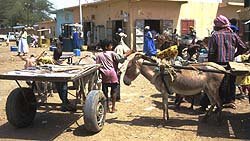
Photo: Donkey
carts in Guinea Bissau
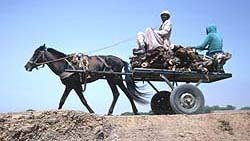
Photo: Horse
pulling cart in The Gambia
Horses and donkeys are susceptible to various health problems and have
distinct ecological niches and management requirements.