| Adoption is not automatic |
|
An innovative and 'spontaneous' use of a cycle trailer in the Czech Repbulic. |

|
Some transport technologies have been launched
with much enthusiasm, but adoption has not been as rapid as anticipated. Some
people have blamed disappointing adoption on inappropriate technologies. Some
have criticised the marketing and promotion systems. In some situations it
appears there were insufficient time and resources to rapidly achieve a
critical mass of users. Cycle trailers provide examples of such disappointing
project progress. In many countries, innovative people have made and used
cycle-trailers. Some have been one-off solutions to an individual's problems.
Some have been developed and manufactured by entrepreneurs. In recent years,
projects have promoted their use and manufacture in several countries including
Ghana, India, Kenya, Sri Lanka and Tanzania. In all cases, the trailers seemed
technically capable, but their adoption was less than planned, even when credit
was made available. Although the advantages and disadvantages of cycle trailers
are well known, there is no consensus about why cycle trailers have not been
more popular. It is not clear whether cycle trailers will ever become common. |
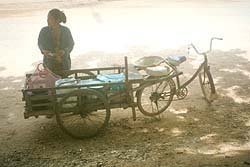 Widespread innovation but
disappointing adoption
Widespread innovation but
disappointing adoption| Cycle rickshaws and cycle trailers Cycle rickshaws and cycle trailers increase the weight and volume of loads carried by a cyclist. Cycle trailers are detachable, allowing the bicycle to be used for personal transport. Both technologies are
Basic cycle rickshaws are much more common: millions are used in South Asia. 'Improved' cycle trailers have yet to become widely used. 'Improved' cycle rickshaws have also yet to become widely used. Is there a problem: if so is it the appropriateness of the technology, the promotional systems or simply the time-span of project initiatives? |
|
Sri Lanka has over two million bicycles in
use. ITDG Sri Lanka has been promoting cycle trailers for ten years, but there
is little optimism about their widespread adoption. This is despite a
participatory and inclusive methodology involving NGOs and small-scale
manufacturers in disadvantaged rural areas. Five cycle trailer prototypes were
introduced to Sri Lanka in 1990. Small-scale workshops were assisted to produce
them. In 1994, a project was initiated to bring 800 trailers into use. The
project identified potential constraints to adoption including economic problems
(low incomes, low agricultural production, lack of
credit) and socio-cultural factors (expectations of public transport services and
desire for prestigious products). The
project worked through small NGOs responsible for promotion and credit.
Marketing and advertising strategies were implemented. Bicycle retailers were
linked to the small-scale workshops. By 1999, only 400 cycle trailers had been
made but the five NGOs and 16 small manufacturers continue trailer promotion.
ITDG Sri Lanka is convinced that disadvantaged rural families can use cycle
trailers to gain real social and economic benefits. The slow uptake is not
understood but there seems little economic demand. It is unclear whether
'mainstream' adoption can be achieved through small workshops or large-scale
manufacture. |
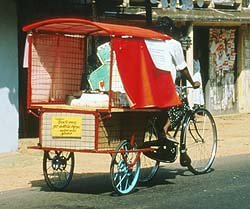 Participative processes but
disappointing adoption: cycle trailers in Sri Lanka
Participative processes but
disappointing adoption: cycle trailers in Sri Lanka