| Learn from experiences | ||
|
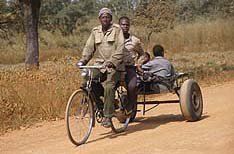 An innovative and 'spontaneous' use of a cycle trailer in Guinea. |
|
Training artisans was not enough The Katopola Agricultural Engineering Centre near Chipata in Zambia provided services relating to vocational training and rural structures. During the 1980s, donor agencies provided nine years' funding including expatriate personnel. School leavers and rural carpenters were taught how to make wooden ox carts, push-carts, wheelbarrows and farm implements. However, there appeared no demand for these, and the carpenters went into furniture production and house carpentry. The project aimed (among other things) to assist rural transport, but despite almost a decade of activity, it had no impact on transport. |
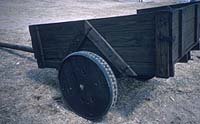 Heavy, wooden carts with wooden bearings proved unpopular in Zambia |
|
|
|
In 1991, subsidised cycle
trailers were promoted in Northern Ghana. Credit was provided through NGOs. Participants
were said to be 'ecstatic'. Workshops in Tamale started production. In 1994,
the programme was evaluated. Women reported that cycle trailers were expensive
and sales were minimal. Women did not generally use cycles. Strong women's
cycles were not available. On the roads, market trucks were used. On footpaths,
the trailers did not work well. The trailers were not strong enough for large
loads. If loaded, the trailers were heavy to pull. Ordinary bicycles were
capable of carrying significant loads and were very flexible at half the price
of a cycle/trailer combination. The evaluation revealed that trailers had been
promoted as a solution without clear understanding of the social, economic and
technical problems and gender issues. |
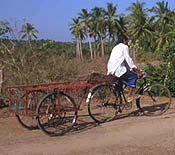 Evaluation lessons from cycle trailers promoted for
women in Ghana
Evaluation lessons from cycle trailers promoted for
women in Ghana